A Japanese Point of View on Manufacturing Consulting and CIPDigital X Innovation—Japanese best practice in manufacturing consulting
09.08.2023 - von Chantal Ruppert, Claudia Schmidt
Lesedauer: 14 Minuten
|

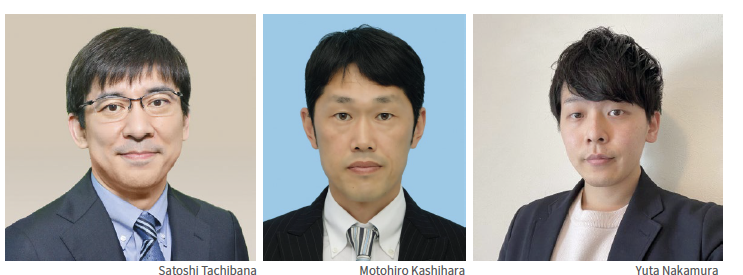
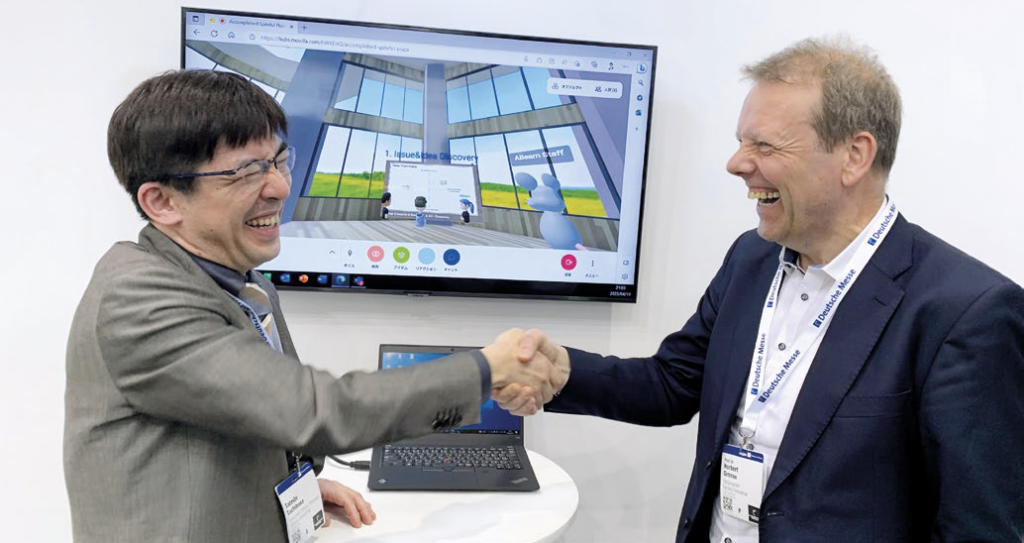
Claudia Schmidt and Chantal Ruppert chat with Satoshi Tachibana, Motohiro Kashihara and Yuta Nakamura about
- four points to observe when implementing KAIZEN
- how executives can boost employee initiative in the continuous improvement process (CIP)
- what companies should consider before starting their digitalization transformation.
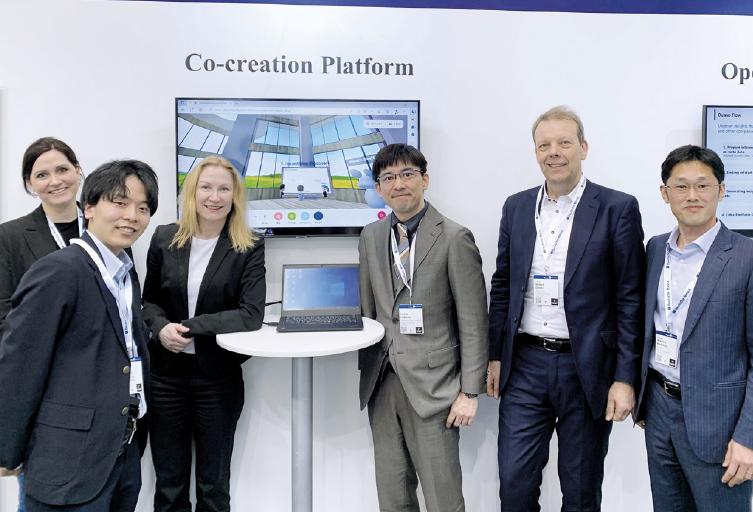
The interview with Japanese Consultancy company ABeam was conducted at the Hanover Fair 2023.
Hello everyone. Thank you for this opportunity to meet at the Hanover Fair. I am really looking forward to our exchange, especially since the lean philosophy originated in Japan. What should our readers know about you before we delve into the world of manufacturing and your work?
Satoshi Tachibana: I am head of the DXI business unit and in charge of creating new businesses in the manufacturing industry as well as developing solutions and services, providing these to our clients and co-creating companies such as large enterprises, startups, and public sector companies.
Motohiro Kashihara: DXI stands for the division “Smart Factory and data-driven manufacturing”. DXI is our digital cross innovation business unit, where we create innovative digital technologies and data. My role is manager at ABeam Consulting.
Yuta Nakamura: I am a senior consultant and responsible for creating new businesses or solutions pertaining to the digital transformation or startup collaboration. Currently I mainly focus on startups in Israel and Singapore.
Many exciting ideas originate from Israel, what you are currently working on?
Yuta Nakamura: We are collaborating with Autofleet – an Israeli company optimizing mobility operation. It’s a good platform to improve mobility solutions and fleet companies.
Does Japanese work ethic stimulate CIP?
Where do you see the main differences in company culture between Germany and Japan?
Satoshi Tachibana: That’s a difficult question, German culture in manufacturing is quite different. We would describe Japanese characteristics as kind and sophisticated. Let me try to pinpoint some differences from my perspective.
Common characteristics:
- High standard of quality: Germany and Japan both have a reputation for producing high-quality products that are reliable and durable. They use rigorous quality control processes to ensure that products meet the highest standards.
- High technical capability: Both have high technological capabilities and can produce excellent products. Both countries place great emphasis on product quality and durability, and actively incorporate the latest technology to achieve this.
German characteristics:
Importance of management: Strategic decisions are made by management and operations are guided accordingly. The role of top management is equally important in Japan, but management actions are stronger in Germany.
Clear Roles and Responsibilities: Each employee performs their duties according to their role and follows instructions from their superiors. They delegate certain powers to subordinate employees. However, the final decision is often made by their superiors.
Japanese characteristics:
Continuous improvement by employees: strong focus on continuous improvement, known as “Kaizen” in Japanese. This means that employees are encouraged to continuously identify areas for improvement in their work processes and implement changes to increase efficiency and quality.
Teamwork: Japanese companies emphasize teamwork and collaboration. Employees work closely together and are encouraged to share their ideas and knowledge to improve the overall efficiency and quality of the product.
Strong Work Ethics: Japanese manufacturing companies invest heavily in the training and development of their employees. They provide extensive on-the-job training and offer opportunities for employees to learn new skills and advance their careers.
In your opinion, what impact does management style have on CIP?
Satoshi Tachibana: In my opinion, in Europe there is often a top-down approach, whereas in Japan there is a bottom-up approach. I have to do it – versus I want to do it – is a totally different attitude. Admittedly, the Japanese bottom-up culture and mindset requires time until it has reached the top. However, in doing so, one can achieve a true and lasting culture of continuous improvement from the bottom up.
In Germany, we have “Betriebliches Vorschlagswesen” to motivate employees. How are employees in Japan motivated to suggest improvements?
Satoshi Tachibana: There is no special reward. CIP is part of every job and expected of every employee. In fact, employees strive and compete to submit the best ideas.
ABeam – a Benchmark in Japanese manufacturing consulting?
So where does ABeam come in? Tell us about ABeam in a nutshell.
Motohiro Kashihara: ABeam is a Japanese consulting company. Our focus is on manufacturing. We combine business, engineering and technology consultancy for Japanese manufacturers.
How international is ABeam – do you have clients also in Germany?
Satoshi Tachibana: Yes, also in Germany. However, our clients are mostly Japanese multinational manufacturing companies – for example Ajinomoto (food manufacturer), Asahi Kasei (chemical industry) or Tier1 auto parts manufacturers like AISIN. We support them internationally to improve production processes and current business solutions and also, to create new business solutions.
Which of your consulting services are most sought after, and in which area do you generate the most revenue?
Satoshi Tachibana: Digitalization. Many Japanese manufacturers have accumulated a lot of knowledge about KAIZEN, see for example the Toyota Production System. Therefore, they are very strong on continuous improvement techniques and know how to improve their production processes. However, in my opinion, Japanese manufacturers need to increase their capabilities in the digital world. There is a high potential for interoperability because they have a lot of information and collaborate with various companies around the world. ABeam can help them to expand their techniques in the digital world.
How long do your typical consulting projects last?
Motohiro Kashihara: It depends. If the customer requires mainly strategy consulting, then it could take maybe three or four months. Often customers decide to continue and take it further, and then our support can last up to two years.
What are the typical problems that customers come to you with?
Satoshi Tachibana: Typical problems involve digital technologies, data utilization and digitalization in Manufacturing. Our customers often lack digital technology experts for manufacturing.
Motohiro Kashihara: For example, the management is expected to do digital transformation, but on the ground level, they don’t know how to approach this huge topic. We can support them in the process how to become a smart factory.
What is your definition of a smart factory?
Satoshi Tachibana: In general, we would define a smart factory as follows: a highly automated and interconnected facility that uses advanced technologies such as artificial intelligence (AI), Internet of Things (IoT), robotics, and other digital technologies to optimize and streamline manufacturing processes.
However, the type of smart factory and the transformation approach should differ for each company depending on various conditions (e. g., level of on-site workers skills, process level of manufacturing, or status of digitalization etc.).
Can you share with us details about a typical consulting project?
Satoshi Tachibana: Company: Chemical Manufacturer
Project:
- Support for formulating a Future Factory concept for manufacturing line managers
Issues:
- Enhance understanding of corporate digital strategy
- Boost self-responsibility mindset of employees
- Adapt planning to new digital strategy
- Strive towards “Future Factory” proactively generated by employees
- Incite a sense of urgency about trends in digital transformation and competitor trends
- Further improve of on-site competitiveness.
Solutions which ABeam offers:
- Concept planning with cross-factory workshops
- Create curriculum based on both manufacturing and technology knowledge
- Real-time provision of cutting-edge industrial trends and examples of digitization of factories
Outcome:
- Created a sense of urgency among on-site staff
- Raised mindset to promote the “Future Factory” concept and employee initiative
- Factory-originated (on-site) short and medium-term plan formulation for strengthening industrial competitiveness
- Updating factory measures based on digital technologies
- “Future Factory” design which is not an extension of the existing one.
Where do you see your USP? What do you do differently than competitors?
Yuta Nakamura: Our differentiator is the end-to-end support from conceptualization to the implementation at manufacturing level. Also, we have multi-industry knowledge (e.g., automotive, parts maker, chemical, or food industry). We have experts who understand sensors, equipment, facilities, and field operations. Therefore, we have the capability of the technology, the ability to utilize shop floor data and the skills to improve the business itself. All this end to end – from strategy to on-site improvements and from shop floor to the top management.
Key issues to consider when implementing Kaizen?
Companies tend to implement bits and pieces of different lean and kaizen methods. Often, they are not implemented optimally. What can companies do better?
Motohiro Kashihara: That’s a good question. When implementing a new KAIZEN method, you need to address four points. If only one is missing, you cannot expect to obtain the planned goal.
- Worker participation: active participation from on-site workers
- Top Management Attention: the management has a thorough understanding of the importance and the method
- Holistic approach: the implementation is based on a correct understanding of the method itself as well as the concept, background, and purpose
- Measurement / Controlling: Implementation of a method to accurately measure results.
ABeam consulting identifies the missing points and bottlenecks and then provides the most effective solution. We have a lot of experience in helping customers with these kinds of issues.
What are some of the methods you use?
Satoshi Tachibana: We usually use 6 Sigma and have a general approach on how to deal with KPI management like the Japanese KAIZEN Way.
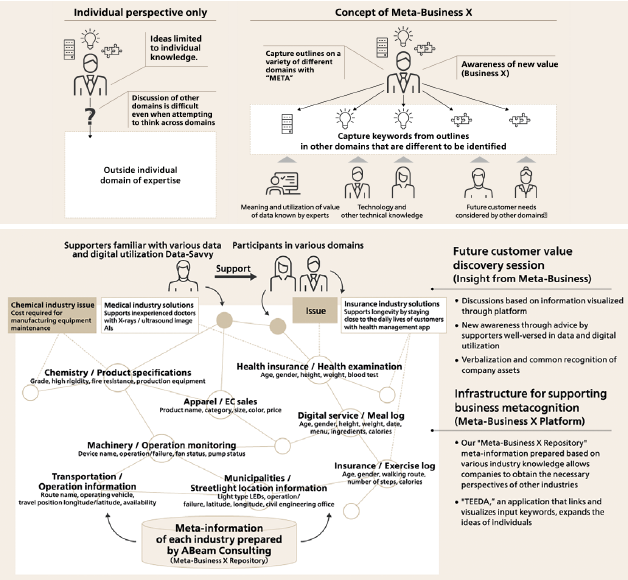
The new Kaizen way – continuous cross-industry improvement discussion
On your website, I read about the “New Kaizen Way”. What is this concept about?
Yuta Nakamura: We reflect about the “New Kaizen Way“ on META BUSINESS X as well. This is an ideation tool and a knowledge platform based on the concept of “metacognition” and visualizes the knowledge of experts. With a panoramic view, individuals can create opportunities and enhance knowledge in non-expert areas. In recent years, all industries have been working toward DX utilizing digital technology and data, but often companies limit activities to replacing existing businesses with digital services, not leading to the creation of new value. To create new value, it is necessary to integrate expertise across individuals, organizations, companies, and industries. This means that information is accumulated and reutilized to allow a continuous cross-industry improvement discussion.
What is ABeam’s vision, and how do you see your role in the transformation towards Industry 4.0?
Yuta Nakamura: The manufacturing industry needs to increase its presence in the digital world. They should be more capable of interoperability and collaboration with various companies. In the world of Industry 4.0, also Japan, needs to experiment more. ABeam needs to find the best way to utilize unique strengths, and we are communicating with companies around the world to find our role to play in the manufacturing Industry.
What are some of the typical challenges that businesses face when implementing IoT solutions?
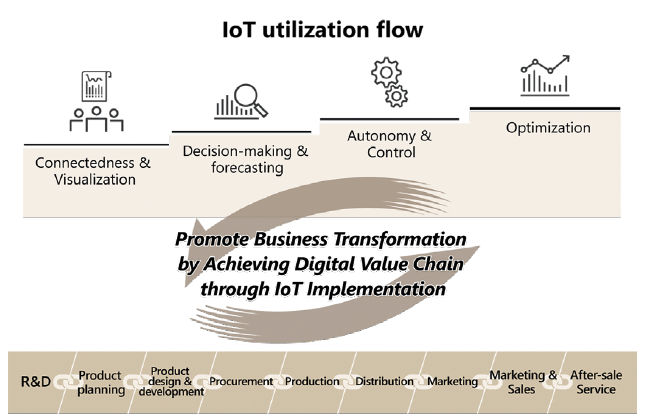
Satoshi Tachibana: I would highlight three typical issues:
- Data-driven visualization of the worksite
- Utilizing Data for Management (Data Driven Management)
- Correspondence with business partners and other interested parties
ABeam addresses these issues with Operational Excellence and KPI management. We call this the data-driven KAIZEN way. This is mainly relevant in the process industry such as food, pharmaceutical and chemical.
The availability of resources is often a critical issue – how are you dealing with this?
Motohiro Kashihara: Resources shortage is a very important point. In the implementation of Industry 4.0 (AI and IoT), it is necessary to build human resources and organizations that can secure it on the client side. Otherwise, clients will always have to rely on vendors and consultants and are hindered in their development. We can support them on how to tackle this topic and provide trainings.
What is your back-up strategy if Executives don’t listen to your advice?
You know the problem and the solution, however your customer politely replies, “Thank you and goodbye” and refuses to address the underlying problems.
Motohiro Kashihara: It sometimes happens.
Satoshi Tachibana: We try to approach all levels, the CEO, the factory manager, the workers, and operators. We bring them together at one table to develop a project into a company-wide activity.
3 tips for companies beginning their transformation:
What are the key considerations that businesses should keep in mind when designing and developing IoT solutions?
Satoshi Tachibana: I would recommend implementing on-site improvements and then try to replace them digitally. Also, it is important to acquire enough IT literacy to implement the measures. With these two points, the approach can be either top-down or bottom-up. It is advised to conduct a thorough assessment how to implement this (e.g., can the data be obtained, what systems should be used, etc.).
For companies starting with digitalization, I have three tips:
- Transparency and access to data, as there is often a lack of knowledge about what is happening at worker level
- Create a fan base of employees and their superiors who can promote this project
- This is not an IT project; only a company-wide team effort can deliver the results and get the data flowing.
New Work tools in manufacturing consulting
There is always a risk of optimizing silos. This needs to be broken down into a real value stream, which leads to the question of how do you support your clients? How has COVID and technology changed the way you work?
Satoshi Tachibana: We have introduced digital tools with photo, video, and online communication tools. Japanese manufacturers have many factories around the world. If we need to access an overseas factory, we use digital tools through a wearable device and online camera. We often do on-site status monitoring in this way.
Motohiro Kashihara: Sometimes we support remote locations by using Microsoft Teams or Google Meet in combination with the use of AR / VR. For example, if the customer is wearing smart glasses, we can see the same as the person on site. That works exceedingly well.
This has certainly reduced travel time considerably. What is your experience of ensuring the security and privacy of data collected through IoT solutions, and what measures need to be taken to prevent unauthorized access?
Motohiro Kashihara: We don’t have any case studies yet. We are in the process of working with security vendors to come up with a solution.
One of the biggest complaints from industry professionals is that consultants often lack practical experience and knowledge. How does ABeam Consulting address this challenge in terms of recruiting and training its consultants, and what measures are taken to ensure that consultants have a well-rounded understanding of industry-specific challenges and opportunities?
Motohiro Kashihara: I am aware of that point. Therefore, we support the customer with a mix of highly experienced and younger consultants, mixed teams bring the best results. In addition, we are hiring people who have done on-site improvements at business companies. We need both consulting experience and business company experience, and we have been working to utilize these assets over the past seven to eight years. For those with a business company background, we’ve improved the way we teach consulting skills while training them for a long time. For those with a consulting background, we teach engineering skills, but it is not something that can be acquired in a short period of time, such as one to two years, it takes time. We can create an ecosystem of companies, but it is difficult to build an ecosystem of people, so we are trying to create an environment where diverse people can influence each other and grow together.
Last question – how is your work changing and what skills will be needed most in the future?
Satoshi Tachibana: Industry 4.0 cannot be achieved without understanding these three issues:
- Business Processes (value-chain wide operations)
- Engineering (mechanical engineering, sensors, systems engineering)
- Computer Science (AI, cloud, and edge computing).
Company Info
Founded: Apr. 1st, 1981
Consolidated Net Sales: approx. 122 billion JPY (approx. ~ 781 million)
Locations: 28 offices (as of Feb. 1st, 2023)
Alliance Locations: 114 offices (as of Feb. 1st, 2023)
Number of Employees: 7,523 (as of Apr. 1st, 2023, ABeam Consulting Ltd. and Consolidated Subsidiaries)
Clients: ABeam offers a wide range of consulting services for various industries, e.g., Ajinomoto, Asahi Kasei, Kaneka, Rinnai, AISIN, ENEOS, Sumitomo Co., etc.
www.abeam.com/eu/en
Division Smart Factory / Data-driven manufacturing
www.abeam.com/eu/en/service_line/iot
Das könnte Sie auch interessieren