Digitalisierung

Human-Centered Revolution in Manufacturing

Trust, leadership, and human ingenuity in the age of Advanced AI
10.11.2025 - von Silvia Hernandez
Lesedauer:  10 Minuten
Human-Centered Revolution in Manufacturing
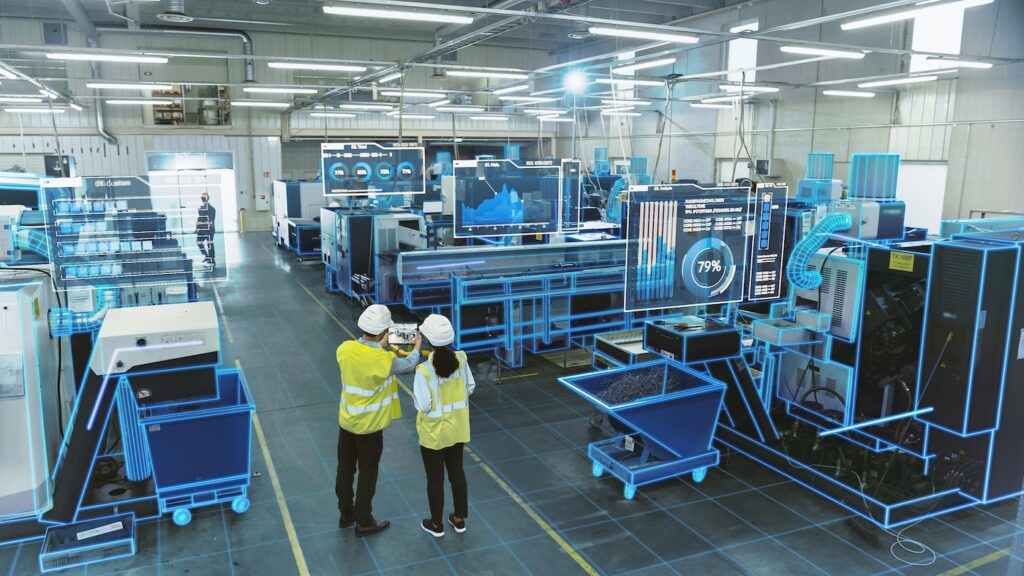
© Adobe Stock/Gorodenkoff

As manufacturing enters the Intelligent Age, the adoption of AI and agentic technologies is transforming production, quality control, and workforce dynamics. However, the true value of these innovations lies in their ability to amplify human potential rather than replace it. A human-centered approach is essential for successful AI and agentic integration in manufacturing, beginning with the imperative to build trust as the foundation for change. Leaders must reinvent their roles by combining digital fluency with curiosity, courage, and connection, which highlights humanness as the ultimate differentiator in an increasingly automated world.

Manufacturing is entering a new era—one defined not just by the rise of generative AI, robotics, and agentic technologies, but by the way humans and machines collaborate to create value. The Intelligent Age promises unprecedented reinvention, with factories leveraging AI-driven production lines, adaptive automation, and predictive analytics. Yet, the true potential of these innovations lies in amplifying human ingenuity, empowering workers to orchestrate technology, optimize workflows, and embed human design into every process. This is not merely a technological revolution; it is a human revolution on the factory floor.

Trust as the foundation of successful AI-enabled reinvention

As AI agents become more autonomous, scaling their impact depends on leaders making trust their top priority. This is not simply a matter of compliance or ticking boxes; it is about embedding transparency and accountability into every aspect of AI deployment. Accenture’s research [1] shows that 77% of executives believe the true benefits of AI are only possible when trust is present, and 81% say trust strategies must evolve alongside technology strategies. However, there is a gap between leaders and workers [2] when it comes to confidence in AI governance, and many organizations still lack a clear roadmap for how AI will reshape their workforce.

High-trust teams consistently outperform their peers in innovation and execution, turning trust from a barrier into a catalyst for growth. In manufacturing, responsible AI ensures safety compliance in autonomous production lines, fair decision-making in workforce scheduling, and transparency in predictive analytics for quality control. Companies that empower their people to take ownership of AI governance outperform in trust and long-term success. Responsible AI is not optional—it’s a differentiator.

Building trust requires more than technical safeguards. It demands open communication about how AI systems work, what data they use, and how decisions are made. Workers need to understand not only the benefits but also the risks and limitations of AI. Leaders must foster a culture where questions are welcomed, concerns are addressed, and ethical considerations are front and center. This transparency builds confidence and encourages employees to engage with new technologies rather than resist them.

Agentic AI refers to artificial intelligence systems that are capable of autonomously taking actions to achieve predefined goals, rather than merely responding to prompts. AI agents can make plans, take decisions, and interact with digital environments or other agents to complete tasks. By combining reasoning, memory, and tool use, Agentic AI moves beyond passive assistance toward proactive problem-solving and execution.

Leading manufacturing through end-to-end operations

Reinvention demands leaders who are architects of change—combining digital fluency with curiosity, courage, and connection. Companies that strengthen both talent and technology are four times more likely to achieve long-term profitable growth. Curiosity drives exploration and the harnessing of disruption, courage enables decisive action in the face of uncertainty, and connection builds trust and empathy across the enterprise.

Leadership in this context means modeling these behaviors every day, encouraging experimentation, and integrating change into the culture. It is about balancing the adoption of AI with a commitment to human values, ensuring that transformation benefits everyone involved. Leaders must move beyond rigid hierarchies and traditional roles, organizing around enterprise purpose and unlocking talent rather than consuming it.

In practical terms, manufacturers should adopt skills-based infrastructures to facilitate transitions between roles, deploy continuous learning in the flow of work, and foster a teach-to-learn culture. These steps not only prepare workers for AI-driven environments but also build resilience and trust—critical capacities in an era where technology alone cannot guarantee success.

The impact and importance of what people do with generative AI today and tomorrow cannot be understated. GenAI and agentic technologies are influencing more than just productivity; they are changing processes across the value chain and redefining the work itself. Due to their ubiquity across job types and potential to create exponential impact, GenAI is poised to provide the most significant economic uplift and change to work since the agricultural and industrial revolutions.

The early industrial revolution was marked by mass production and standardized outputs. The age of Advanced AI will be defined not only by productivity gains but also by enhanced human creativity and the potential to shape more innovative employee and customer experiences. For the first time in history, we are embracing a generation of technology that is “human by design.” GenAI’s effectiveness hinges on human input to drive quality outputs—whether they’re straightforward, like the draft of an email, or complex, like a financial forecast. This shift will lead to a reinvention of work with more human-centric processes across the entire value chain.

By synthesizing data, comprehending natural language, and converting unstructured data into actionable insights, GenAI is democratizing business process redesign, empowering everyone—from frontline workers to lab scientists to design professionals—to reshape their own workflows. GenAI can also bring workers closer to their customers by transforming the customer experience: from using AI-powered analytics to gain a comprehensive view of customer needs, to customizing products and services based on those needs. This end-to-end change not only streamlines operations; it also helps manufacturers know their customers better, identify new products, and improve experiences for both customers and employees.

All these outcomes positively impact the bottom line. In fact, research shows that generative AI offers a trifecta of opportunities: it can accelerate economic value and increase productivity that drives business growth while fostering more creative and meaningful human work. Comparative analysis of global GenAI adoption and innovation scenarios shows that more than $10.3 trillion in additional economic value can be unlocked by 2038 if organizations adopt GenAI responsibly and at scale. This potential is reflected in CxO optimism, with most believing GenAI will ultimately increase their company’s market share, and 17% anticipating an increase in market share by 10% or more.

Recognizing human ingenuity as the ultimate differentiator

As GenAI becomes pervasive, human skills—creativity, empathy, and psychological safety—are the true differentiators. Most executives expect GenAI agents to work alongside humans within the next few years, but only a fraction of workers have received the necessary training. When leaders frame AI as a catalyst for creativity and innovation, workers become more confident in adapting to new ways of working. Elevating human ingenuity means championing human-centered leadership, investing in upskilling, and designing experiences where AI augments human strengths rather than replacing them.

Generative AI offers incredible potential, but without human intelligence to guide, shape, and apply it, its value is limited. Success hinges on people’s ability to reimagine work, develop new skills, and collaborate effectively with AI systems. In manufacturing, this means shifting from traditional machine operation to roles that orchestrate AI-driven processes and manage collaborative robots [3]. It also involves moving from manual quality checks to AI-assisted oversight that ensure compliance and ethical standards.

Accenture’s study reveals that 95% of workers see value in working with generative AI, and 94% are ready to learn new skills. However, only 5% of organizations are reskilling at scale. This disconnect underscores the urgency for manufacturers to invest in talent strategies early, not as an afterthought. Organizations leading in AI adoption are twice as likely as others to anticipate productivity gains of 20% or more within three years, largely because they actively involve employees in redesigning workflows and roles.

The report also highlights a trust gap: while workers are optimistic, 58% worry about job security and 60% fear increased stress and burnout, compared to only 37% of leaders who acknowledge these concerns. Closing this gap requires transparency, communication, and a commitment to addressing employees’ emotional, physical, and financial well-being alongside skill development. Organizations that achieve this unlock two-thirds of an individual’s potential, translating into measurable business growth.

The Industrial, Information, and Intelligent Ages mark three major waves of transformation that overlap rather than replace one another. The Industrial Age perfected mechanization, standardization, and mass production—machines augmenting and increasingly replacing human labor. The Information Age digitized the world, connecting people and systems through data, networks, and computing power. Today’s Intelligent Age builds on both: infusing intelligence into machines and processes. Still, even at a time when AI systems enable autonomous execution, manufacturing, information management, and human expertise remain deeply intertwined.

In practical terms, manufacturers should adopt skills-based infrastructures to facilitate transitions between roles, deploy continuous learning in the flow of work, and foster a teach-to-learn culture. These steps not only prepare workers for AI-driven environments but also build resilience and trust—critical differentiators in an era where technology alone cannot guarantee success.

Fairness, transparency, and accountability cannot be automated. In manufacturing, responsible AI ensures safety compliance in autonomous production lines, fair decision-making in workforce scheduling, and transparency in predictive analytics for quality control. Companies that empower their people to take ownership of AI governance outperform in trust and long-term success. Responsible AI is not optional—it’s a differentiator.

The future lies in collaboration, not competition. AI should be seen as a teammate or a skilled intern—not a threat. Emerging agentic architectures enable dynamic systems where humans and AI agents co-create, problem-solve, and continuously learn together. In manufacturing, this means cobots working alongside humans on assembly lines, guided by AI algorithms but supervised by human judgment. This shift requires new roles, new workflows, and above all, a culture of experimentation and adaptability.

To thrive in the Intelligent Age, manufacturers must embed responsible AI into production processes to ensure safety and compliance. Leaders need to learn and execute in new ways, moving beyond rigid functions to organize around enterprise purpose. Unlocking talent rather than consuming it is critical, which means upskilling for AI orchestration and fostering a culture of adaptability. Above all, organizations must create clarity of purpose and shift mindsets—from fear of automation to embracing augmentation. This is not incremental change—it’s a reinvention of work itself.

The human revolution behind AI

The Intelligent Age isn’t about machines replacing humans—it’s about amplifying human potential. Manufacturers that embed purpose into AI systems and empower their people will define the next era of industrial value. Technology may anchor transformation, but humanity drives it. By making trust the cornerstone, leading with curiosity and courage, and elevating humanity, manufacturing leaders can build resilient, innovative organizations that harness the full potential of AI—ensuring that the future of work is both productive and profoundly human.


Bibliography

[1] Accenture: Accenture Technology Vision 2025: New Age of AI to Bring Unprecedented Autonomy to Business. 2025. URL: https://newsroom.accenture.com/news/2025/accenture-technology-vision-2025-new-age-of-ai-to-bring-unprecedented-autonomy-to-business, accessed 17.11.2025.
[2] Accenture: Accenture Report Finds Perception Gap Between Workers and C-suite Around Work and Generative AI. 2024. URL: https://newsroom.accenture.com/news/2024/accenture-report-finds-perception-gap-between-workers-and-c-suite-around-work-and-generative-ai, accessed 17.11.2025.
[3] Accenture: Rethinking the course to manufacturing’s future. Research Report. 2025. URL: https://www.accenture.com/us-en/insights/industrial/future-of-manufacturing, accessed 17.11.2025.


Das könnte Sie auch interessieren

Digitale Transformation erfolgreich gestalten

Digitale Transformation erfolgreich gestalten

Von der Vision zur nachhaltigen Umsetzung
Die digitale Transformation verläuft für jedes Unternehmen unterschiedlich und erfordert einen individuellen Weg, der zur eigenen Ausgangslage passt. Entscheidend ist eine klare Strategie: Wo steht das Unternehmen heute, wo soll es hin und welche Maßnahmen sind dafür nötig? Besonders KMU stehen vor der Herausforderung, Digitalisierung strukturiert zu planen, Verantwortlichkeiten zu klären und neue Technologien sinnvoll einzusetzen.
Wir können Zukunft – die DACH-Region als Weltmeister der Ideen

Wir können Zukunft – die DACH-Region als Weltmeister der Ideen

Ein Blick auf Erfolge, Erfindungen und Menschen, die weltweit Maßstäbe setzen
Wir können Zukunft: Die DACH-Region zeigt, warum sie als Weltmeister der Ideen gilt. Von Smart Factories über digitale Zwillinge bis zu kollaborativer Robotik entstehen hier Innovationen, die weltweit Maßstäbe setzen. Substanziell statt spektakulär, präzise statt laut –Technologien, die sich unter Realbedingungen am Shopfloor beweisen und messbare Ergebnisse liefern. Ein Blick auf Menschen, Unternehmen und Erfindungen, die Zukunft gestalten.
Software-Defined Automation made in Germany

Software-Defined Automation made in Germany

Nahtlose Konvergenz von IT und OT formt die Fabrik der Zukunft
Was einst deutsche Stärke war, gerät in Bewegung: Die SPS verliert ihren Alleinstellungsanspruch, IT und Edge übernehmen. Während Industriegrößen an alten Konzepten festhalten, entstehen viele Innovationen in kleinen agilen Unternehmen –häufig aus Übersee. Doch auch in Europa und gerade in Deutschland werden inzwischen moderne Lösungen entwickelt, die die Versprechen von Industrie 4.0 und darüber hinaus endlich wahr werden lassen.
Hyperautomatisierte Fabriken sind mehr als Technologie

Hyperautomatisierte Fabriken sind mehr als Technologie

Systematisch denken, intelligent verknüpfen – Automatisierung mit Wirkung
Hyperautomation gilt zwar als technologische Vision, doch die Praxis zeigt: Ihr volles Potenzial entfaltet sie durch die Kombination von Tools, strukturiertem Prozessverständnis und wertschöpfungsübergreifender Zusammenarbeit. Vier zentrale Erfolgsfaktoren sind entscheidend für hyperautomatisierte Fabriken.
Visuelle Anomalieerkennung in der industriellen Praxis

Visuelle Anomalieerkennung in der industriellen Praxis

Few-Shot Learning und Human-in-the-Loop machen KI praxisreif
Visuelle Anomalieerkennung gilt als Schlüsseltechnologie für die Qualitätssicherung in der Industrie. Doch hohe Datenanforderungen und komplexe Anpassungen erschweren den Praxiseinsatz. Neue KI-Ansätze wie Few-Shot Learning und Human-in-the-Loop kombinieren Effizienz mit Flexibilität und ermöglichen eine nahtlose Verbindung zwischen Forschung und industrieller Anwendung –ein wichtiger Schritt hin zu robusten, selbstlernenden Qualitätssystemen.